Show Search & Discovery · podcast transcript search
Podcast Transcript Search: Why Raw Text Files Fail
Pasting transcript text dumps into AI chat windows is slow and inaccurate. Here is how structured metadata and index partitioning solve search accuracy.
author
Hassan Ali
published
updated
read
5 min
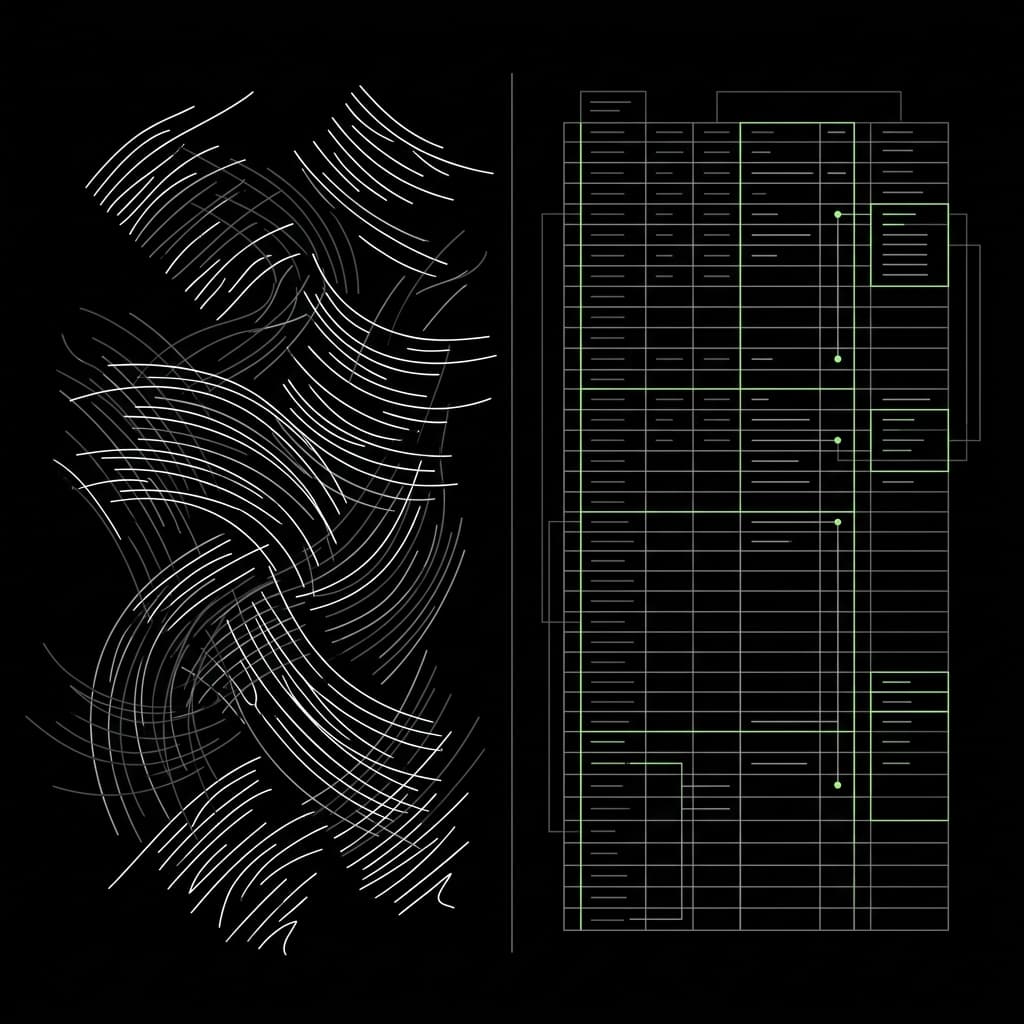
If you have tried searching your podcast archives by pasting a massive TXT file of an episode transcript into ChatGPT or Claude, you have run into the limits of raw text.
The chat window either runs out of memory, misses the key point entirely, or hallucinates a quote that was never actually recorded.
Executing a dependable podcast transcript search across a back catalogue of hundreds of episodes requires more than just dumping raw transcription text into an LLM window. It requires structured metadata and partitioned indexing.
Here is why raw text files fail, and how a structured database architecture solves the problem.
1. The Context Window Trap (Memory Bloat)
An hour-long podcast transcript contains roughly 8,000 to 10,000 words. If you have 100 episodes, that is nearly a million words.
While modern models boast large context windows, loading a million words of raw text into a single session is slow, expensive, and impractical. Every time you ask a question, the entire text must be read again. This creates massive latency, making quick queries impossible.
The Solution: The data layer splits transcripts into small, logical paragraphs (chunks) linked to specific timestamps. When you ask a question, only the relevant segments are retrieved and passed to the model, keeping the session fast and lightweight.
2. Needle in a Haystack (Loss of Detail)
LLMs suffer from "loss in the middle"—a documented phenomenon where a model is excellent at reading the beginning and end of a long text document but overlooks details buried in the middle.
If you paste a 45-page transcript, and ask about a quick guest remark on page 22, the AI is highly likely to miss it. It will either give a generic summary or claim the topic was never discussed.
The Solution: By indexing chunks semantically using vector embeddings, the search system isolates the exact paragraph where the conversation occurred. The model is given a 200-word block to read rather than a 10,000-word dump, ensuring absolute accuracy in the response.
3. The Hallucination Problem (Lack of Grounding)
When an AI is given raw, unformatted text files, it has no hard structural boundaries. It treats speaker names, timestamps, and page numbers as simple words.
If the transcript has typos or spelling errors in guest names, the AI will build its assumptions on those mistakes. If it cannot find a quote, its default behavior is to guess, producing believable but completely fictional remarks.
The Solution: In a structured database, every transcript segment is bound to a verified episode ID, guest profile, date, and external link. The AI is instructed to only return information that can be mapped to these verified entities, eliminating its ability to invent quotes.
4. Lost Source Context (No Citation Path)
A raw text file has no metadata. If the AI finds a useful point in your text, it cannot tell you: What episode it came from. The exact timestamp in the audio. * The link to the show notes or guest’s website.
Without these connections, a transcript search is only half-useful. You find the answer, but you cannot verify it or point your audience to the source.
The Solution: The data layer keeps a self-referencing map. Every transcript block knows its parent episode details. When the AI answers, it outputs the verified title, date, and canonical URL alongside the quote, establishing a complete citation path.
Why Structure Beats Fluff
Building a searchable podcast archive is an architectural challenge, not an AI prompt challenge. Dumping raw files into standard tools is a temporary fix that fails as your library grows.
By treating your show’s transcripts as structured, clean databases, you unlock search precision that actually reflects what you and your guests recorded. Save the raw files for backup; use a structured data layer for search.
Why can't I just dump my entire transcript folder into ChatGPT?
Context limits make pasting large folders slow and expensive. LLMs also suffer from 'needle in a haystack' syndrome, where they miss key details buried in the middle of long raw text documents.
How does structured search prevent AI hallucinations?
By linking transcripts directly to verified metadata (guest profiles, dates, topics), the database provides hard constraints. The AI is forced to cite exact timestamps and verified files instead of making up answers.
What is semantic search in podcasts?
Semantic search uses vector coordinates to search by the meaning or context of a discussion, rather than just matching exact keywords, making it easy to find topics even if you don't remember the exact words used.
Your podcast, inside ChatGPT and Claude.
Paste your podcast link. Your episodes come in automatically. Ask your AI anything about your show.
Join founding beta